
 CN
CN EN
EN News
News
Konsemi Shines at AI+AR Glasses Salon: Decoding How Storage Chips Redefine Terminal Boundaries
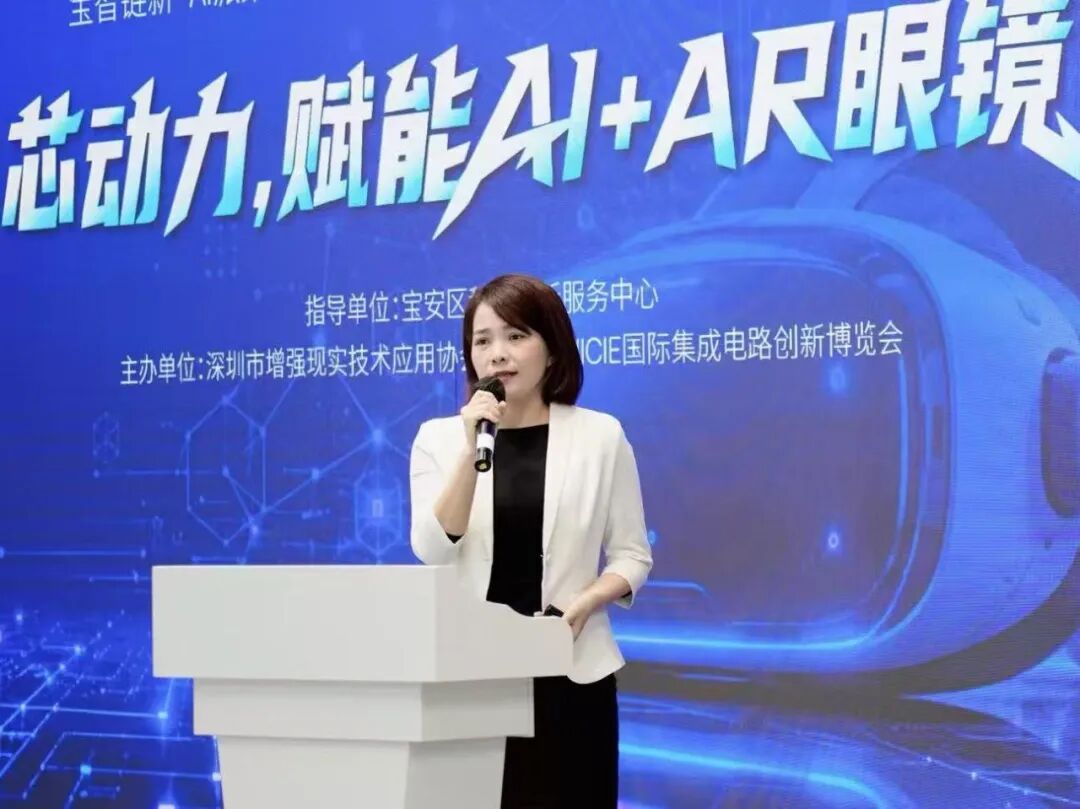
On July 10, 2026, Konsemi was invited to attend the special salon "Chip Power Empowering AI+AR Glasses," where Liang Huaihua, General Manager of the Market Planning Department, delivered a keynote speech titled "'Chip' Storage Reaches High, Intelligent Computing Shapes the Future — Storage Chips Reshaping the New Boundaries of AI+AR Glasses."

As one of the domestic enterprises with full-stack self-development capabilities in the embedded storage chip field, Konsemi appeared at this event with a storage solution for the full scenario of AI+AR smart glasses, showcasing to the industry the application path of storage chips in the development of end-side AI.
Starting from the underlying storage architecture, the speech analyzed the core contradictions of smart glasses among computing power, power consumption, volume, and interactive experience, and provided Konsemi's systematic answer oriented toward "small size, high performance, and low power consumption."
Breaking Through End-Side Implementation with Storage Power
The accelerated deployment of end-side large models is driving AI+AR glasses to evolve from "minimal information prompters" to "all-weather AI assistants."
The implementation of application scenarios such as multimodal interaction, real-time voice translation, and visual SLAM mapping has placed higher requirements on the terminal's data throughput capability and response speed. And everything behind this ultimately points to the performance boundaries of the underlying storage chip.
However, as a typical compact wearable device, smart glasses usually have relatively limited space inside the temples. The battery, motherboard, optical modules, and sensors already occupy the vast majority of the volume, leaving a relatively small area for storage components.
At the same time, the high-frequency data reading and writing brought by multimodal AI interaction requires storage chips to have the characteristics of high bandwidth, strong error correction, and low latency.
How to achieve a balance among capacity, performance, and power consumption within limited space has become an important topic for upgrading the smart glasses experience, and is also a challenge that storage chip design must face.
Small Size Releases Great Energy
In response to the above industry needs, Liang Huaihua focused in her speech on introducing Konsemi's small-size eMMC embedded storage products for compact terminals such as AI glasses and smart watches.
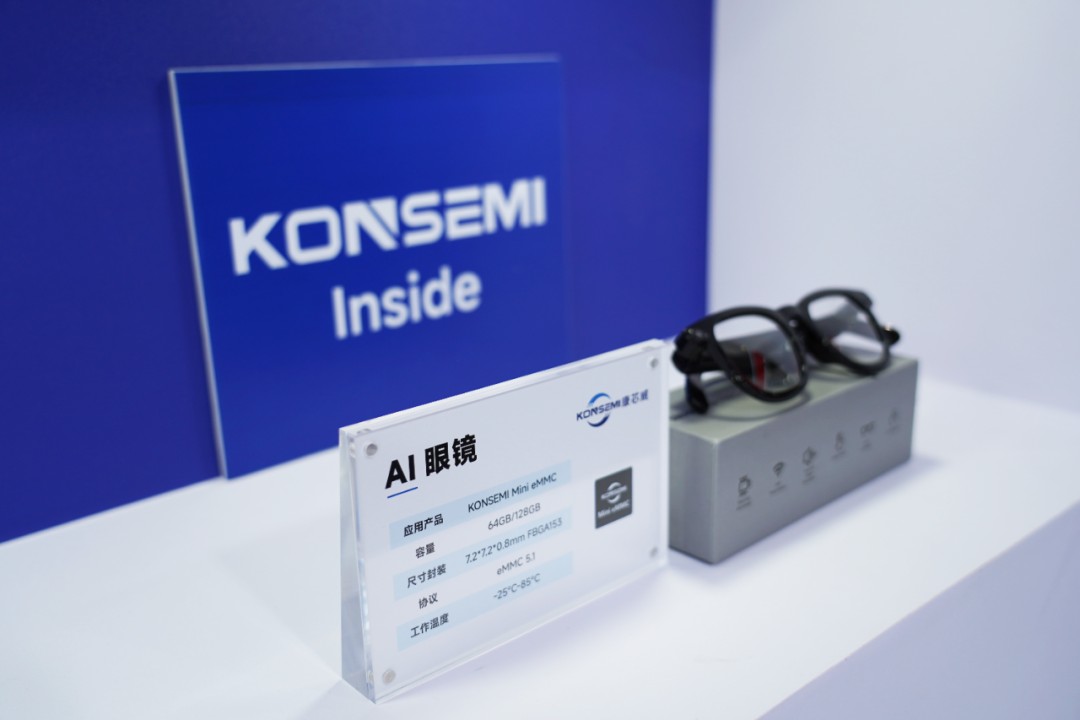
In terms of product characteristics, Konsemi's small-size eMMC has the following features:
First, extremely compact. It adopts a compact packaging solution and can be embedded into the temple space of smart glasses without additionally increasing the weight and heat dissipation burden of the whole device.
Second, low-power design. It has a built-in intelligent power management module and supports low-power modes such as deep sleep, which helps extend terminal battery life and reduce temple heating issues under high-load scenarios.
Third, reliable performance. It is equipped with a fourth-generation LDPC error correction algorithm, providing support for the real-time and stable throughput of massive data in multimodal AI interaction, and providing a "storage power" foundation for the smooth operation of end-side large models.
Liang Huaihua stated that what Konsemi provides is a "storage-computing collaboration" solution designed from the underlying storage architecture and customized for AI+AR glasses.
Through innovative design at the storage chip end, Konsemi helps device manufacturers break through the physical boundaries of space and power consumption, promoting the experience upgrade of smart glasses from "usable" to "easy to use."
Full-Stack Self-Development Empowers the Industry
This salon "Chip Power Empowering AI+AR Glasses" was jointly organized by the IICIE International Integrated Circuit Innovation Expo, the Shenzhen Augmented Reality Technology Application Association, and Xinshiye, aiming to gather enterprises in core links such as end-side computing, chips, and storage, promote upstream and downstream collaboration in the industrial chain, and explore the evolution path from underlying hardware to application scenarios.
Through its participation and technology sharing at this salon, Konsemi further clarified the differentiated needs of AI+AR glasses for storage chips, and also provided the industry with reference ideas from chip design and solution verification to terminal implementation.
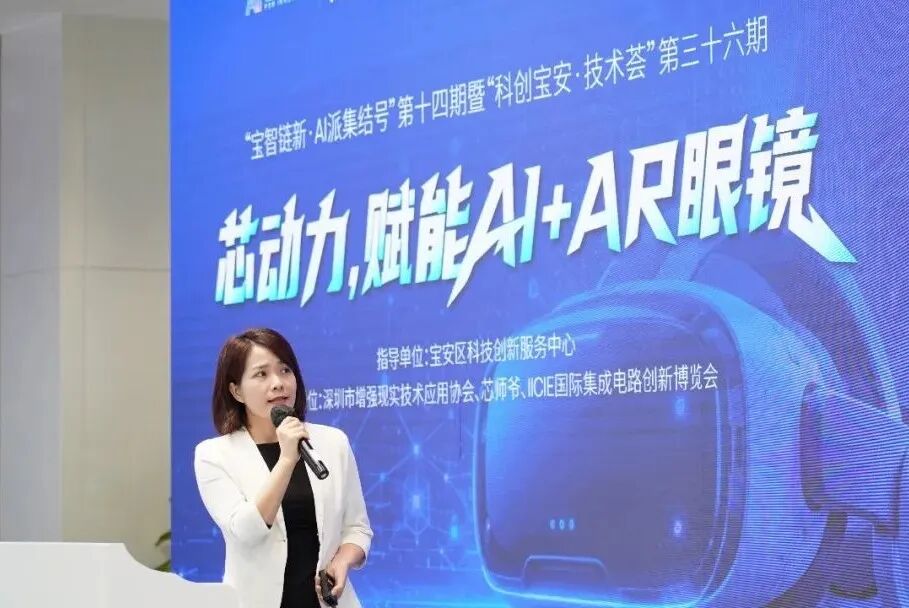
Liang Huaihua stated in her speech that with the continuous increase in the penetration rate of end-side AI, the composite demand of smart glasses for storage chips — "larger capacity, smaller size, lower power consumption, and higher reliability" — will further emerge.
In the future, Konsemi will continue to cultivate deeply in embedded storage core technologies and join hands with industry partners to jointly advance the development of AI+AR glasses.